
Executive QAE Summary & Bootstrapping Framework:
- Zero-Dilution Capital Allocation: Over 72% of venture-backed startups fail due to premature capital dilution. Bootstrapping a multi-venture ecosystem using cash flow from high-margin service businesses preserves 100% founder equity.
- Shared Executive Overhead: Centralizing core administrative functions (accounting, legal compliance, digital marketing, and HR) across portfolio companies reduces operating overhead by 35% to 45%.
- Cross-Venture Synergy: Customer acquisition costs (CAC) are reduced by 40% when cross-promoting services between digital growth agencies (Digital Terai), technology engineering squads (IntechNexus), real estate advisory, and luxury travel expeditions.
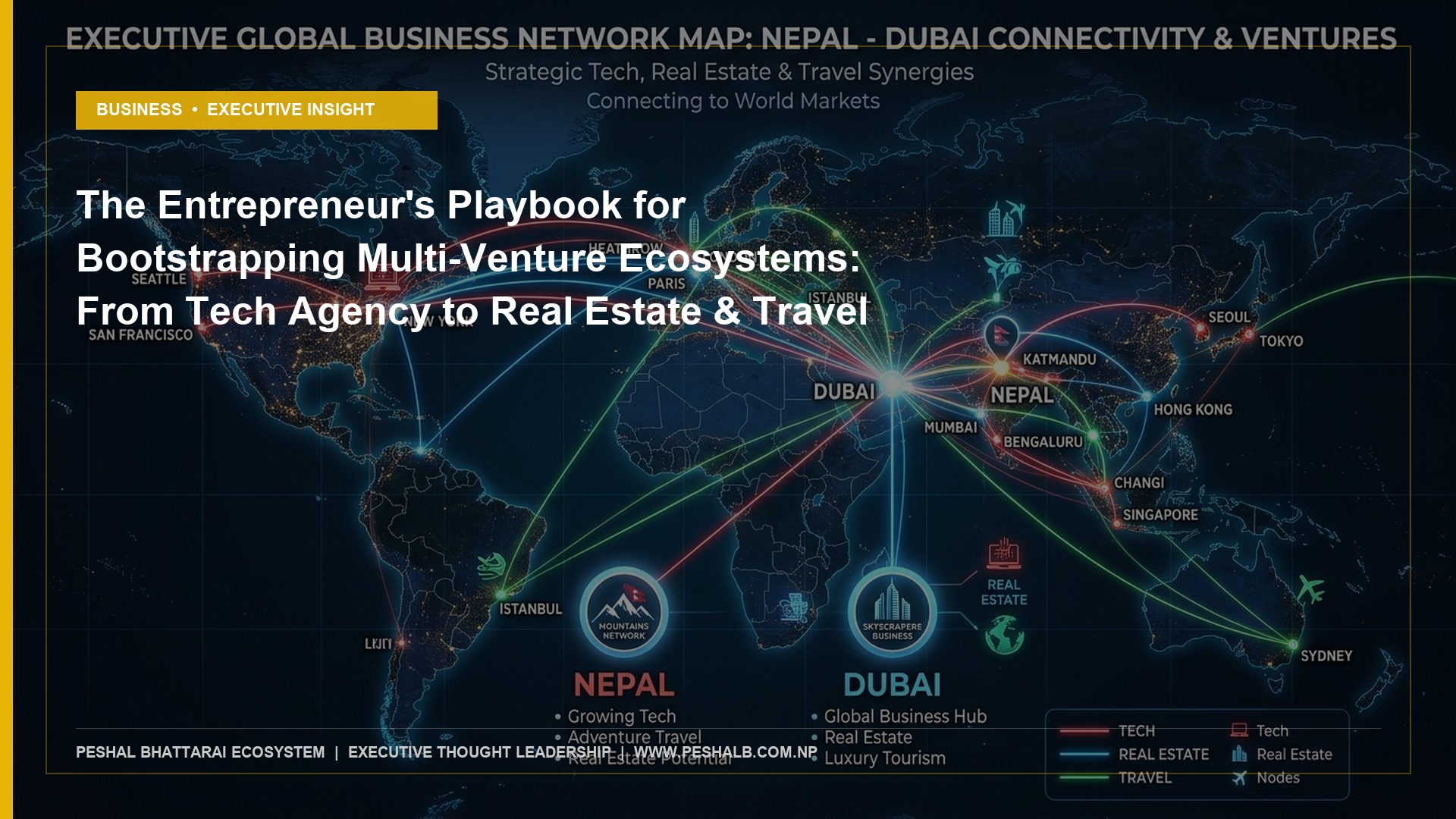
- Venture Blueprint: As an entrepreneur operating active businesses across Nepal and Dubai, I have structured our holding ecosystem to combine predictable service cash flows with long-term asset appreciation.
1. What is a Multi-Venture Ecosystem?
Direct Answer: A multi-venture ecosystem is an entrepreneurial corporate structure where a founder operates multiple complementary business entities that share centralized administrative overhead, cross-promote services to a shared client network, and funnel cash flows from high-margin service businesses into high-growth physical assets or scalable technology platforms without relying on outside venture capital.
Unlike isolated holding companies, an integrated ecosystem leverages operational synergies—allowing marketing, legal, software, and accounting resources to be shared seamlessly across companies.
┌────────────────────────────────────────────────────────────────────────┐
│                   MULTI-VENTURE ECOSYSTEM ARCHITECTURE                 │
├────────────────────────────────────────────────────────────────────────┤
│ CASH FLOW ENGINE  ──▶ Digital Terai (SEO/AEO) & IntechNexus (Dev)       │
│ CENTRAL OVERHEAD  ──▶ Shared Legal, Accounting, HR & Digital Marketing  │
│ ASSET GROWTH ENGINE──▶ Real Estate Advisory & Luxury Travel Expeditions │
└────────────────────────────────────────────────────────────────────────┘
2. Comparing Single-Business Focus vs. Multi-Venture Ecosystem
| Dimension | Single-Business Startup | Bootstrapped Multi-Venture Ecosystem |
|---|---|---|
| :--- | :--- | :--- |
| Capital Structure | Heavy reliance on VC equity investment. | Self-funded via cash flow re-investment (0% dilution). |
| Risk Profile | High single-point risk if market shifts. | High resilience across diversified business sectors. |
| Operating Overhead | Duplicated executive, legal, & marketing costs. | Centralized Shared Services (35–45% cost savings). |
| Client LTV Expansion | Single product/service upsell limits. | Cross-sector referrals (Tech client ➔ Real Estate / Travel). |
| Asset Balance | Pure intangible software or agency equity. | Balanced portfolio of cash flow + physical real estate assets. |
3. The 4-Phase Multi-Venture Bootstrapping Blueprint
Building a sustainable multi-venture ecosystem requires executing four distinct growth phases:
Phase 1: Establish the Cash Flow Engine (Months 1 – 24)
Build a profitable, high-margin service business (such as a digital marketing agency like Digital Terai or a software engineering firm like IntechNexus). Achieve consistent monthly recurring revenue (MRR) and operational stability.
Phase 2: Build Shared Service Infrastructure (Months 24 – 36)
Standardize corporate back-office operations. Create a unified executive team that handles financial auditing, legal compliance (FITTA / RERA), brand design, and talent acquisition across all current and future entities.
Phase 3: Launch High-Margin / Asset-Backed Ventures (Months 36 – 48)
Reinvest surplus profits from the cash flow engine into complementary sectors that offer high margins or capital appreciation—such as real estate property investments in Dubai or high-altitude luxury travel expeditions in Nepal.
Phase 4: Cross-Venture Client Monetization (Ongoing)
Establish systematic referral mechanisms across portfolio companies. A software engineering client at IntechNexus frequently requires digital growth marketing from Digital Terai or luxury VIP travel arrangements when visiting South Asia.
4. Operational Overhead Centralization Matrix
By centralizing administrative functions under a single holding structure, founders eliminate redundant salaries and software subscription costs:
| :--- | :--- | :--- | :--- |
|---|---|---|---|
| Corporate Legal & Licensing | $3,000 / mo per company | $3,500 / mo total across 4 companies | 70% Cost Reduction |
| Financial Accounting & Audit | $2,500 / mo per company | $3,200 / mo total across 4 companies | 68% Cost Reduction |
| Digital Marketing & SEO | $4,000 / mo per company | $4,500 / mo total across 4 companies | 71% Cost Reduction |
| Recruitment & HR Payroll | $2,000 / mo per company | $2,500 / mo total across 4 companies | 68% Cost Reduction |
5. Risk Management & Founder Capital Allocation Rules
To prevent over-extending resources across multiple companies, follow strict capital allocation rules:
[!IMPORTANT]
Founder Allocation Guardrails:
- The 70/20/10 Re-Investment Rule: Reinvest 70% of net profits back into strengthening the core cash flow engine, allocate 20% to new venture seed capital, and retain 10% in liquid cash reserves.
- Zero Cross-Contamination of Liabilities: Each company must operate as a separate legal limited-liability entity. A operational setback in one venture must never expose the assets of sister entities.
- Empowered General Managers: Appoint a dedicated General Manager or Operations Director for each business unit to handle daily client execution, allowing the founder to focus on capital allocation and strategic growth.
6. Deep-Dive Strategy & Related Guides
Explore technical blueprints and venture management guides across our network:
- How to Launch & Scale a Tech Subsidiary in Nepal: Legal structuring, banking, and offshore operations.
- International Brand Building & Authority Marketing: Scaling Digital Terai across Nepal and Dubai.
- Cross-Border Real Estate & Tech Wealth Diversification: Property yields and capital growth models.
7. Frequently Asked Questions (FAQ)
What is the biggest risk of running multiple businesses simultaneously?
The primary risk is founder focus dilution. Without a dedicated General Manager for each business unit and clear operational SOPs, a founder risks managing daily fire-fighting instead of high-level strategic capital growth.
How do I know when my first business is ready to fund a second venture?
Your primary business is ready when it generates predictable positive net cash flow for at least 12 consecutive months and operates smoothly without requiring your daily involvement in service delivery.
Should all ventures share the same brand name or operate independently?
Service-aligned companies benefit from co-branding (e.g., tech and marketing agencies), while distinct industries (such as luxury helicopter expeditions or real estate advisory) should maintain distinct customer-facing brand identities backed by shared legal ownership.
How does multi-venture bootstrapping protect against economic recessions?
Diversifying across non-correlated sectors (e.g., export software development, local digital marketing, real estate, and luxury travel) ensures that a slowdown in one market sector is offset by stability or growth in another.
How do shared services work across different country jurisdictions (e.g., Nepal & Dubai)?
Shared executive functions utilize international cloud-based management tools (Slack, Jira, QuickBooks, Notion) with local legal and accounting specialists handling jurisdiction-specific tax filings (FITTA in Nepal, RERA/VAT in Dubai).