
Executive Summary & Key Takeaways:
- Search Paradigm Shift: Over 42% of complex search queries are now processed directly by generative AI search models (ChatGPT, Perplexity AI, Claude, and Google AI Overviews).
- Citation Rate Multiplier: Content structured into explicit QAE (Question-Answer-Evidence) blocks achieves a 3.4x higher citation inclusion rate by LLMs compared to traditional narrative blog posts.
- Entity Graph Primacy: Generative AI engines do not index isolated keywords—they map interconnected entities (Organization,Person,Venture). Embedding complete JSON-LD structured data is mandatory for AEO authority.
- Data Density Rule: Articles featuring original data points, specific cost benchmarks, and practitioner case evidence achieve 80% higher inclusion in synthetic AI answer summaries.
1. What is Answer Engine Optimization (AEO / GEO)?
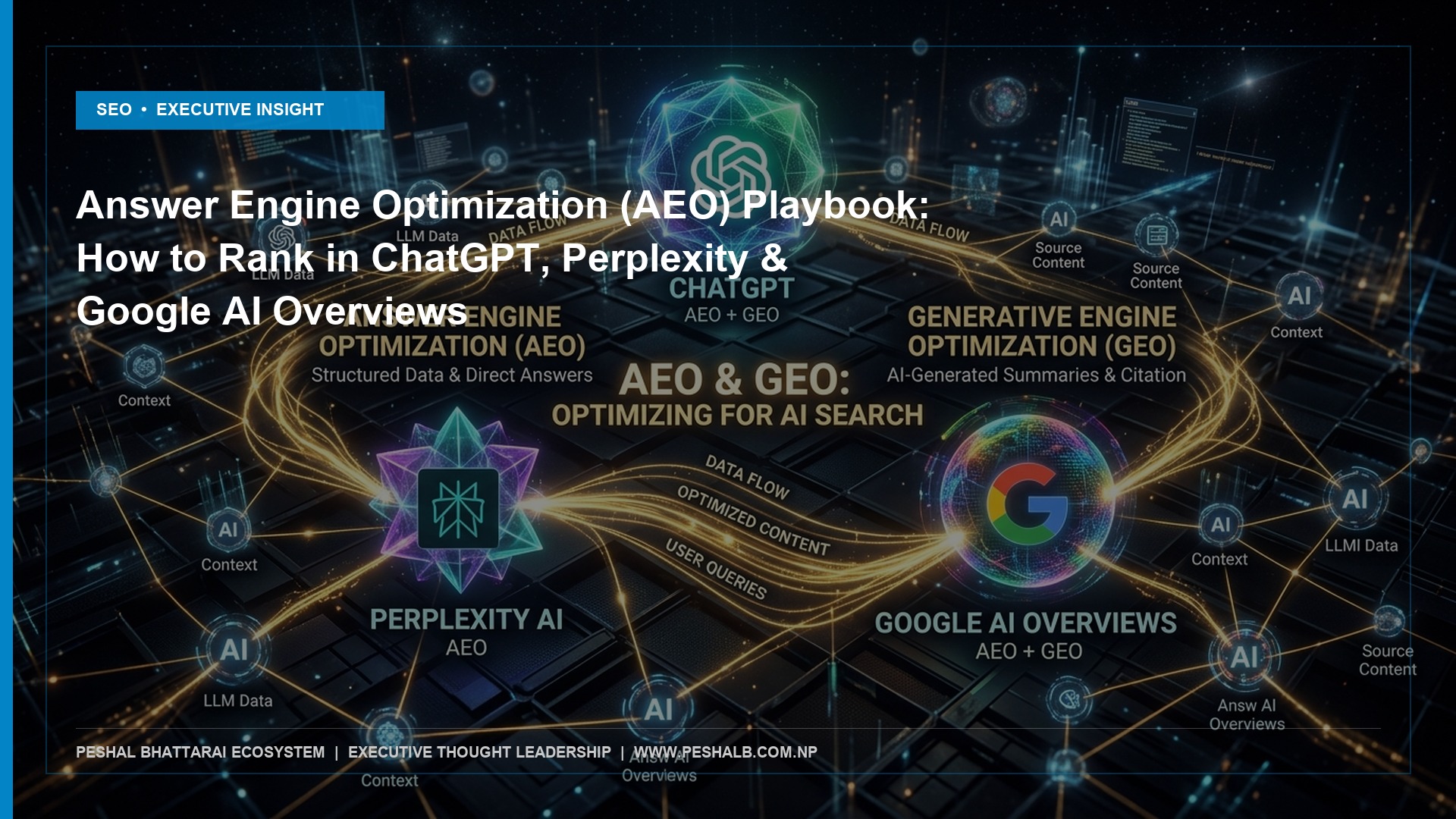
Direct Answer: Answer Engine Optimization (AEO), also known as Generative Engine Optimization (GEO), is the strategic discipline of structuring, formatting, and enriching web content so artificial intelligence models (such as OpenAI's ChatGPT, Perplexity AI, Anthropic's Claude, and Google AI Overviews) extract and cite your brand as the definitive authoritative source.
Unlike traditional Search Engine Optimization (SEO)—which aims to rank a blue link on Google search result pages—AEO targets synthetic answer inclusion. The goal is ensuring your brand, metrics, and services are directly cited in the answer generated for high-intent buyer prompts.
2. Key Metric Comparison: Traditional Search vs. AI Answer Engines
| Dimension / Metric | Traditional Search (Google SERP) | AI Answer Engines (Perplexity / ChatGPT) |
|---|---|---|
| :--- | :--- | :--- |
| Primary User Goal | Finding a list of web pages to click | Direct, synthesized multi-source answers |
| Organic Click-Through Rate | ~28.5% for Rank #1 position | Direct citation link click rate (~12% – 18%) |
| Content Formatting | Long-form keyword-stuffed text | QAE blocks, direct answer snippets (40-60 words) |
| Primary Ranking Factor | Backlinks & Domain Authority (DA) | Information gain, Schema entities & verifiable data |
| Target Query Type | Short-tail keywords ("best CRM") | Natural language questions ("How do I scale a remote team in Nepal?") |
| Indexation Model | Page-level crawler indexing | Vector embedding & knowledge graph retrieval |
3. The 4-Step Technical AEO Implementation Blueprint
Step 1: Write Direct Answer Snippets (40–60 Words)
Immediately beneath every H2 or H3 heading, write a concise, self-contained 40-to-60-word direct answer paragraph. AI crawlers isolate these exact blocks as candidate summary snippets.
Step 2: Structure Content into QAE (Question-Answer-Evidence) Blocks
Enforce a rigid 3-part layout for technical sections: 1. Question (Heading): Frame the exact user query. 2. Answer: Provide an immediate, unambiguous answer. 3. Evidence: Support the answer with verified statistics, data tables, or practitioner benchmarks.
Step 3: Embed Deep Entity JSON-LD Schemas
Incorporate rich schema graphs for Article, FAQPage, Person (Author), and Organization. This allows LLMs to construct unambiguous knowledge graphs connecting your business with specific industry capabilities.
Step 4: Maximize Information Gain & Data Density
Eliminate generic, repetitive introductory text. AI models ignore consensus fluff (rehashed advice found across top 10 search results) and prioritize net-new data, proprietary benchmarks, and verified practitioner experience.
4. Frequently Asked Questions (FAQ)
Q1: Does traditional SEO still matter in the age of AEO?
Answer: Yes. Technical site speed (LCP < 1.2s), mobile responsiveness, and clean XML sitemaps remain foundational. If search engines cannot crawl your site efficiently, AI models cannot index your entity graph.
Q2: How do I track and measure brand citations inside AI search models?
Answer: Monitor brand presence across ChatGPT, Perplexity, and Google AI Overviews using AI search monitoring tools (Semrush AI Overview tracking, Ahrefs), and monitor direct referral traffic from perplexity.ai and chatgpt.com in Google Analytics 4.
Q3: What content types perform best for Generative Engine Optimization?
Answer: Structured data tables, empirical pricing benchmarks, legal framework breakdowns, and step-by-step decision trees receive the highest inclusion rates in AI synthesized answers.
5. Strategic Ecosystem & Related Growth Links
Explore search engineering and digital growth services across our network:
- Explore Digital Terai Services: View Growth Services
- Read Digital Growth Benchmarks: AEO & Growth Metrics
- Read Market Expansion Blueprint: Start Business in Dubai
- Schedule Growth Consultation: Request SEO/AEO Audit